1300 799 943 Enquire Now

The Complete Mine Site Water Cart Guide: What to Consider Before You Specify

Choosing a mine-site water cart is one of those decisions that has a big impact on day-to-day operations. Get the specification right and dust control, road conditions, and site safety stay on track. Get it wrong and you’re dealing with frustrated operators, higher maintenance, and a cart that struggles to keep up with the site.

This guide keeps things simple and practical. It covers the main specs and design choices that genuinely matter on a mine site, and what to look for if you want a water cart that’s reliable, compliant, and built to handle tough conditions.

Why the right water cart specification matters on mine sites

Mine sites are tough on equipment, and water carts cop a lot of punishment. When the spec isn’t matched to the environment, it shows fast with poor dust control, stability issues, breakdowns, and operators who don’t want to drive the equipment.

The specifications matter because it directly affects:

  • Dust suppression performance – enough water, the right spray pattern, and proper pressure to actually hold the dust down.
  • Safety on haul roads – stability, traction, visibility, and controlled water output.
  • Compliance – meeting environmental and site safety requirements without cutting corners.
  • Uptime – a cart built for the terrain stays in service longer and doesn’t spend half its life in the workshop.
  • Lifecycle cost – the right tank, chassis, and components save money long-term, even if the upfront cost is higher.
  • Operator confidence – if the cart feels stable and the controls make sense, the job gets done properly.

Understanding the operating environment (operating ‘envelope’)

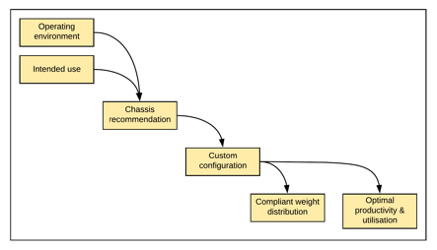
Before you can choose the right tank, pump, or spray setup, you need to understand the operating ‘envelope’ (basically the conditions the cart needs to work in and the limits it has to stay within to perform properly). When you know the terrain, the loads, the travel cycles, and the site conditions, you can spec a water cart that actually holds up in day-to-day use.

Once the key operating factors are clear, you can match the cart to the right chassis, tyres, and suspension. This part is easy to underestimate. Off-road chassis setups vary a lot, and two 8×4 trucks can have completely different carrying capacities. In some cases, the right choice can mean carrying 50% more water, cutting refill trips, and making a noticeable difference to uptime and productivity.

At Shermac, this is the first thing the engineering team looks at. We take the operating environment into account before recommending anything. It’s a simple step, but it’s the reason our carts hold up well in remote and high-demand sites.

Core specifications to consider for a mine-site water cart

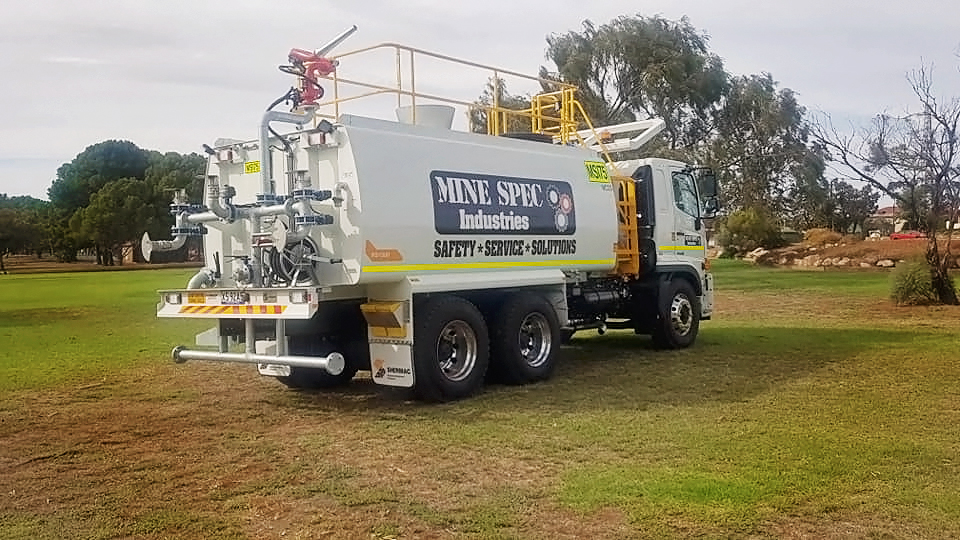
Mine-spec water cart spraying water across an unsealed haul road for dust suppression on a mine site
Close-up of Shermac water cart rear spray bar delivering controlled dust suppression on a mining road.
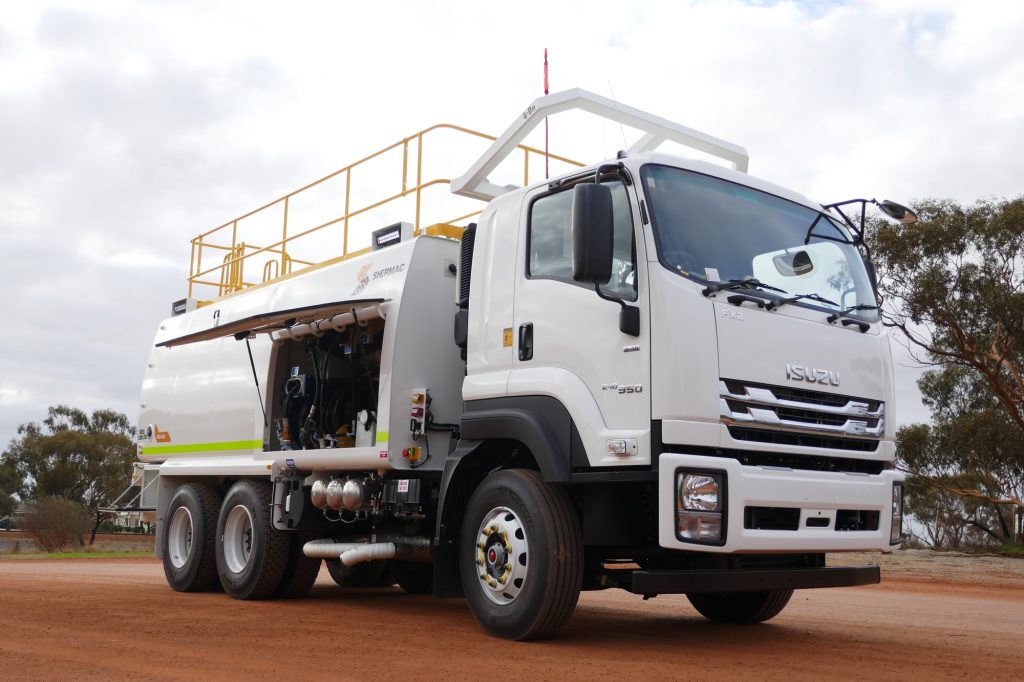
Shermac mine-site water cart using dual water cannons for long-range dust control in mining operations.

Once the operating environment is understood, the next step is getting the technical specifications right. These are the parts of a water cart that influence how well it performs on a mine site.

Water tank capacity

The tank needs to suit the size of the haul roads, the distances covered, and how often the cart can realistically refill. Too small, and you waste time cycling to water points. Too large, and you overload the chassis. Matching the tank to the workload is what keeps dust suppression consistent throughout a shift.

Chassis selection

Not all 8×4 or heavy-duty chassis are equal. Payload, suspension, wheelbase, and off-road capability vary massively between models. The right chassis determines how much water you can carry safely, how stable the vehicle feels, and how well it handles rough sections, climbs, or long haul routes.

Weight distribution and tank design

A low centre of gravity is essential on mine roads. Shermac’s curved tank design improves stability and removes stress points that cause cracks in flat-walled tanks. Better distribution means safer handling, less chassis strain, and fewer structural failures over the cart’s life.

Pump system

A reliable pump with the right flow rate and pressure ensures the cart can maintain proper coverage across different road surfaces. Variable flow or speed control is a bonus, letting operators adjust output based on dust conditions.

Spray system layout

Mine sites need flexibility. This could mean:

  • rear spray bars
  • dribble bar for slower work or tighter control
  • water cannon for long-reach applications
  • removable fin-style nozzles for easier cleaning

The design should deliver even, predictable coverage without wasting water.

Control system

Operators should be able to control spray zones from inside the cab. Being able to turn individual sprayers on and off saves water, improves accuracy, and avoids constant stopping and starting.

Water filtration

Dirty or sediment-heavy water is common on mine sites. Good filtration protects pumps and nozzles, reduces blockages, and keeps spray patterns consistent.

Safety and compliance features

Depending on the site, this may include mine-spec lighting, access systems, handrails, emergency stops, spill control, and fire response features. These are critical for site compliance and operator safety.

Maintenance accessibility

Daily checks and routine servicing should be simple. If key components are easy to reach and nozzles can be cleaned quickly, the cart spends more time working and less time parked up waiting for maintenance.

Lifecycle cost, reliability, and ROI considerations

The upfront price does matter, but it’s often the long-term costs that separate a good water cart from one that becomes a headache. The way the tank is built, how the chassis handles the load, and how easy the system is to service all play a part in the true cost of ownership.

Things that influence lifecycle cost and overall ROI include:

  • Build quality – stronger tanks, proper weight distribution, and mine-spec components reduce failures over time.
  • Tank integrity – designs that avoid stress points (like Shermac’s curved tanks) prevent cracking and the downtime that comes with it.
  • Serviceability – easy access to pumps, filters, and nozzles means quicker maintenance and fewer delays.
  • Parts availability – local support and fast parts supply keep the cart working rather than waiting in the workshop.
  • Fuel and water efficiency – good spray layout and in-cab control reduce unnecessary water use and repeat passes.
  • Operator confidence – reliable, predictable handling reduces incidents and keeps productivity steady.

Why Shermac is a trusted choice for mine-spec water carts

Shermac has been building purpose-built mine-site water carts since 2002. We’re an Australian, family-owned business, and everything we build is designed for the kind of harsh, remote conditions most fleets deal with every day. That focus comes from years of working closely with mining and civil teams across the country and understanding what actually holds up on site.

Over the years, we’ve designed and engineered equipment for some of the biggest names in the industry, including BHP, Rio Tinto, Fortescue, Thiess, Komatsu, and Alcoa. A lot of that work has involved solving tough problems or building highly specialised units that need to perform in environments most gear simply doesn’t survive.

Setting your fleet up for long-term success

Getting the specification right is the difference between a water cart that works hard every day and one that constantly holds your site up. When the tank design, chassis, spray system, and controls all line up with the conditions you’re running, you end up with a safer, more reliable operation.

If you’re looking at mine-spec water carts and want some practical advice on what will suit your site, the Shermac team is always happy to have a chat.

Reach out on 1300 799 943 or [email protected], or get in touch through the website. We’re here to help you get the right setup from day one.

When deciding on a service vehicle to support on-site service operations, several important factors need to be considered, including: 

Depending on the industries served, the service vehicle may need to traverse rough terrain or navigate challenging road conditions. Understanding the job the vehicle is expected to do and the environment where it will work is critical to chassis selection, so look for a supplier that can offer a wide range of chassis options. Correct chassis selection is the cornerstone of the vehicle operating envelope which, in turn, underpins reliability, durability, and predictable lifetime cost.  

With constantly changing fluid levels, weight distribution is a critical factor in vehicle safety, so look for a supplier that demonstrates expertise in weight distribution. This is particularly important for safe operation of truck and trailer combos and calculating additional equipment loads. 

The supplier should have the capacity to configure fluid carrying volumes to reflect the duty cycle of the vehicle. Fluid storage should be bunded to minimise the potential for fluid spills and dispensing systems must safely and reliably dispense these fluids at the required flow rate. 

High quality, industrial strength equipment with a proven track record is essential for reliable service operations and vehicle productivity and utilisation. 

Equipment must be configured to optimise operator effectiveness when performing service operations and routine maintenance tasks. Effective operator maintenance is one of the pillars of predictable lifetime cost. 

Operators will often be required to perform repetitive tasks during a shift, so ergonomics is an important consideration for operator wellbeing. This may include cab entry and exit, hose rollout and rewind, and easy-open doors.  

Safety is paramount when operating a service vehicle, especially when traveling to remote or hazardous job sites. Look for vehicles equipped with advanced safety features such as stability control and advanced driver assistance systems (ADAS) to enhance safety. 

In addition to operating envelope and operator maintenance, the third leg of lifetime cost is scheduled maintenance. Suppliers should provide easy access to technical support and carry an adequate inventory of spare parts. 

Operating envelope, operator maintenance and routine maintenance are the key drivers of lifetime cost and a supplier with a strong focus across these three areas will result in the lowest lifetime cost of ownership. 

Choose a service vehicle from a reputable manufacturer known for quality, reliability, safety and excellent customer support. A strong brand reputation ensures confidence in the vehicle’s performance and provides access to reliable service and support resources when needed. 

——— 

Borne out of the need for high quality, engineered-for-purpose industrial vehicles and equipment, and established in 2002, Shermac is an Australian family-owned business that specialises in support vehicles, including service trucks, for the mining, civil and commercial sectors.    

The Shermac team has a deep understanding of operating in remote areas of Australia, so can relate to the tough conditions that customers deal with on a daily basis. Shermac has designed, engineered, and fabricated products for some of the worlds’ largest mining and civil engineering contractors, including BHP, Rio Tinto, Fortescue, Thiess, Komatsu, and Alcoa. Much of this work has been to address highly specialised requirements demanding one-off engineering solutions to operate in some of the most hostile environments on earth.   

If you’d like to discuss your next project, please call our team on 1300 799 943 or email [email protected] with your inquiry.    

Shermac have been designing and building service trailers for mining, civil, and commercial operators across Australia since 2002. The latest range of service trailers from Shermac are a culmination of two decades of experience and continuous improvement.

Standard models include the smaller MTS1500 that is typically less than 2,000kgs when full, with an aggregate fluid carrying capacity of approximately 1,000L, and the larger MTS2000 which can be up to 3,500kgs, with a fluid carrying capacity of approximately 1,750L.

So why are Shermac service trailers the ultimate on-site service solution for small or large operations?

Tailored configurations for unmatched versatility

Service trailers can be configured to suit the specific needs of customers. At the heart of this adaptability are custom-size self-bunded tanks for diesel, oil, grease, coolant, and water. Roto-moulded polyethylene tanks are stronger, more robust, and lighter than steel tanks and, available in a range of sizes, they can be configured, with appropriate dispensing equipment, to support any application or need.

Built tough to go anywhere

Engineered to ‘mine-spec’ standards, Shermac Service Trailers are primed to tackle the harshest environments. All equipment is mounted on a heavy-duty trailer with a unique Shermac chassis design and equipped with over specified, locally sourced suspension, axles, wheels and brakes. All dispensing equipment is securely enclosed in lockable compartments, ensuring durability and protection.

Operator-centric ergonomics

Shermac prioritises operator safety and comfort. Conveniently located hose reels and operating equipment at waist height, along with spring rewind hose reels, provide ease of use. Lightweight one-piece swing-up aluminium doors with gas stay supports ensure security and provide weather protection for the operator. Our trailers are well equipped with work lights and courtesy lights illuminate the interior of the canopy.

Lower weight increases versatility

Combat weight restrictions with Shermac’s innovative use of roto-moulded poly tanks. Not only are they extremely durable, but they also contribute to weight savings of up to 600kg per trailer. This weight efficiency allows for additional tools, parts, and fluids, enhancing operational capabilities.

Power supply options

Shermac service trailers offer several power supply options including an air connection at the front of the trailer to utilise the compressor on the towing vehicle or on-board diesel-powered compressors or generators.

Fully featured for maximum efficiency

Benefit from a comprehensive set of standard features unique to Shermac service trailers. Options abound, including metered control nozzles, product filtration, spare wheels, and a high-pressure washer, providing a fully equipped solution.

Waste oil management made easy

Trailers are equipped with a waste fluid system that is configured with a diaphragm pump for evacuating and out-loading waste fluids direct from the machine. Standard configurations also include a draining station for filters that drains waste oil directly into the waste oil tank.

Availability and short lead times

In a world of supply chain uncertainty, the use of smart forecasting, a focus on locally made components and long-term supply relationships significantly reduces lead times. Customers benefit from short lead times and can still configure trailers to best suit their requirements.

Unlocking value with lowest cost of ownership

Shermac service trailers offer not just the right price but the lowest lifetime cost. Tailored configurations optimise performance, selected equipment ensures reliability, and design facilitates quick and easy operator maintenance.

End-to end support

Shermac service trailers are manufactured in Western Australia and delivered to clients anywhere across Australia and New Zealand. With on-demand technical support, substantial parts inventory, and a national support network, you can rely on Shermac to help you optimise productivity and utilisation.

Enhance your brand

Shermac service trailers are a serious workhorse for professional operators and say a lot about your approach to support and service. With large single-piece doors providing ample space for promotional material, these trailers become an ideal mobile signboard for your business.

Experience you can rely on

The Shermac team has a deep understanding of operating in remote areas of Australia, so we can relate to the tough conditions that customers deal with every day. Shermac products reflect the sum of our experience and a passionate desire to push boundaries and provide our customers with unmatched peace-of-mind.

Australian-made

Shermac have been manufacturing superb quality service trailers in regional Western Australia for over 20 years. When you select Shermac products, you are supporting a family-owned business, a regional employer, and a passionate supporter of the communities in which they live and work.

—–

If you’d like to learn more about Australia’s best and most versatile service trailer, please call our team on 1300 799 943 or email [email protected] with your inquiry.  

Shermac have been designing and building service trailers for mining, civil, and commercial operators across Australia since 2002. The latest range of service trailers from Shermac are a culmination of two decades of experience and continuous improvement. 

If you are considering a Shermac Service Trailer, the following information will help you learn how to specify your Shermac Service Trailer.

What is the towing vehicle and what are the weight limits for the vehicle and trailer? 

As a reminder: 

  • The Gross Vehicle Mass (or GVM) is the maximum laden weight of the vehicle, including the kerb weight of the vehicle plus driver, passengers, luggage, tow bar, bull bar, any other accessories and the towbar download weight.  
  • The Aggregate Trailer Mass (or ATM) is the same as GVM except for your trailer. It includes the trailer and the trailer load.  
  • The Gross Combination Mass (or GCM) is the maximum allowable weight of a towing vehicle, its trailer and load. 

Reviewing weight limits will determine the maximum weight of the trailer that you can legally tow behind your vehicle. 

Shermac has two standard models of service trailers. The smaller MTS1500-2 is typically less than 2,000kgs when full, with an aggregate fluid carrying capacity of approximately 1,000L. The larger MTS2000-2 which can be up to 3,500kgs, with a fluid carrying capacity of approximately 1,750L.  

What is the intended use of the service trailer? 

By understanding the range of machinery to be serviced and a typical daily run sheet, Shermac can work with you to determine the fluid types and volumes to be carried and configure the trailer to meet your specific needs.  

At the heart of this adaptability are custom-size self-bunded tanks for diesel, oil, grease, coolant, and water. Roto-moulded polyethylene tanks are stronger, more robust, and lighter than steel tanks and, available in 300L, 200L and 100L (To be confirmed) sizes, they can be configured, with appropriate dispensing equipment, to support any application or need. 

Do you need an onboard grease dispensing system?  

If required, Shermac service trailers can be fitted with a pneumatic grease pump equipped to suit a 20kg grease pail. The dispensing system includes a 15m spring rewind hose reel. 

Does the towing vehicle have an air compressor that can be utilised by the trailer? 

If yes, Shermac will install an air connection at the front of the trailer to utilise the compressor on the towing vehicle. If not, you will need an independent power supply such as an on-board diesel-powered compressor or generator. 

What type of tow coupling is installed on the towing vehicle? 

This will ensure that the trailer is supplied with a compatible coupling

Do you require any specific options to be installed? 

While Shermac service trailers benefit from a wide-range of standard features, trailer options include upgraded LED work lights, metered control nozzles, product filtration, additional spare wheels, and a high-pressure washer. If you have any special requirements, please feel free to discuss with Shermac. 

Do you have any specific colour, livery, or branding requirements? 

Standard Shermac service trailers are supplied with white paint, but custom paint colours are available. Shermac trailers boast an aesthetically pleasing exterior and large single-piece doors provide ample space for promotional material and are an ideal mobile signboard for your business. 


Shermac’s end-to-end manufacturing capability, focus on locally made components and long-term supply relationships means that customers benefit from short lead times and can still configure trailers to best suit their requirements.  

If you’d like to learn more about Australia’s best and most versatile service trailer, please call our team on 1300 799 943 or email [email protected] with your inquiry.  

Reliability refers to a vehicle’s ability to operate continuously and perform its expected role safely and as intended, without unplanned downtime or interruptions.  

For more than 20 years, Shermac have been designing and manufacturing service vehicles for the Australian mining industry. With a deep understanding of operating in remote areas of Australia, we can relate to the tough conditions that customers deal with every day, and we understand the critical importance of vehicle reliability to customer operations. 

Shermac’s reputation and success has been founded on engineered-for-purpose equipment and the adoption of a strategic approach to reliability management that ensures every vehicle is of a necessary standard for its intended use. 

Shermac’s approach to reliability management begins with a review of the intended “operating envelope” of a vehicle. This refers to a range of conditions and parameters within which the vehicle can safely and effectively operate. It defines the boundaries within which the vehicle’s performance, capabilities, and components are designed to function optimally. The operating envelope considers various factors that can impact the vehicle’s operation such as load capacity, environmental conditions, terrain and road conditions, and regulatory requirements.  

Shermac’s approach to reliability management encompasses the following:  

Dependability: Dependability ensures that the vehicle can consistently meet the demands of its job. A Shermac service vehicle can be counted on to be available when needed and be ready to perform its tasks without unscheduled downtime.  

Performance: A Shermac service vehicle will deliver consistent performance to meet or exceed operational expectations. It will be capable of performing its designated tasks efficiently and effectively, ensuring that services are delivered without delays or performance bottlenecks. 

Durability: Durability ensures a Shermac service vehicle can maintain its performance and functionality over an extended period. A Shermac service vehicle will be able to withstand the operating conditions of its intended working environments, such as rough terrain, extreme temperatures, dust, vibrations, and other demanding factors.  

Safety: Every Shermac service vehicle prioritises operator safety and ergonomics. It will be equipped with appropriate safety features and comply with relevant safety regulations to operate in a safe manner to minimise hazards that could impact both the vehicle operator and other personnel on the mine site. 

Maintenance: Shermac service vehicles incorporate smart design that makes it easy for operators to conduct regular inspections and perform routine preventative maintenance, supported by well-defined maintenance schedules and procedures. 

Spare Parts and Support: Shermac service vehicles are supported by a reliable supply chain for genuine parts, as well as access to technical support and expertise when required. This ensures that maintenance needs can be quickly addressed, minimising downtime, and optimising the vehicle’s reliability. 

Shermac has unprecedented experience in engineered-for-purpose service vehicles that operate safely, efficiently, and effectively within their intended operating envelope, optimising productivity and utilisation, and minimising operational risk for our customers.  

If you’d like to discuss your next project, please call our team on 1300 799 943 or email [email protected] with your inquiry.     

In Australia, a ‘mine-spec’ vehicle refers to machinery that has been specifically modified or designed to meet the safety, durability and regulatory requirements that are specific to mine safety standards.  

There are no universal or nationally mandated ‘mine-spec’ standards in Australia. Instead, the concept of ‘mine-spec’ typically refers to a set of specifications and modifications that are customised for each mining operation based on specific requirements, regulations, and safety considerations. These specifications and modifications vary depending on the type of equipment or vehicles being used, the mining environment, and the relevant state or territory regulations. 

The mining industry is subject to various safety and compliance regulations that govern equipment, vehicles, and operations. Some of the key regulatory bodies and standards include: 

  • Safe Work Australia: Safe Work Australia provide guidance on various aspects of safety, including the use of equipment and vehicles in mining operations. 
  • State and Territory Regulations: Each Australian state and territory may have its own mining safety regulations and guidelines. These regulations can vary slightly from one jurisdiction to another but generally adhere to national safety standards. 
  • Australian Standards: The AS/NZS series includes standards applicable to equipment used in mining. While not specific to ‘mine-spec’ vehicles, these standards often provide guidance on safety features and requirements. 
  • Industry Associations: Various industry associations may provide guidelines and best practices related to safety and equipment use in the mining sector. 

While there are no universally standardised ‘mine spec’ regulations in Australia, the core principles of ‘mine spec’ vehicles and equipment typically revolve around safety, durability, and compliance with relevant regulations.  

Here are some common features found on a ‘mine spec’ vehicle: 

Enhanced Safety Features: 

  • Battery isolation with lockout mechanism 
  • Always-on headlights 
  • Elevated taillights 
  • Emergency egress options 
  • Falling Object Protection Systems (FOPS) 
  • Fire suppression systems 
  • ID signage 
  • Roll-Over Protection Systems (ROPS)  
  • Wheel nut indicators 

Durability and Robustness 

  • All terrain tyres 
  • Heavy-duty suspension 
  • Reinforced frames 

Environmental Considerations 

  • Bunding systems 
  • Emissions control 

Operator Comfort and Ergonomics 

  • Climate control 
  • Dust control 
  • Ergonomic seats 
  • Noise reduction features 
  • Vehicle access systems 

Ease of Maintenance 

  • Accessible components and service points 
  • Self-reporting systems 

While ‘mine spec’ vehicles may have a higher upfront cost, long term value is created through their durability and reduced maintenance needs and often lead to a lower total cost of ownership over their lifespan. In addition, ‘mine spec’ vehicles often hold their value better in the resale market due to their durability, compliance, and reputation for safety. 

———

Shermac is an Australian family-owned business that has been fabricating high quality, mine-spec water carts and service vehicles for the mining sector since 2002. The Shermac team has a deep understanding of operating in remote areas of Australia, so we can relate to the tough conditions that customers deal with on a daily basis. Shermac has unprecedented experience in engineered-for-purpose water carts and service vehicles that operate safely, efficiently, and effectively within their intended operating envelope, optimising productivity and utilisation, and minimising operational risk for our customers.    

If you’d like to discuss your next project, please call our team on 1300 799 943 or email [email protected] with your inquiry.

The use of diesel-powered equipment has created long-term challenges for the mining industry.  

The exhaust produced by burning diesel fuel is a complex mixture of gases, vapours, liquid aerosols, and particulate substances. These include hazardous chemicals such as nitrous oxide, nitrogen dioxide, sulphur dioxide and carbon monoxide. Particulates include fine carbon particles to which hazardous chemicals, known as poly aromatic hydrocarbons, can adhere and, because of their small size, when inhaled can penetrate deep into the lungs and increase the risk of heart and lung disease. 

In underground settings, risk mitigation has required the installation of extensive ventilation infrastructure. 

Reducing CO2 emissions 

In addition to health and safety, diesel vehicles account for 30%-50% of greenhouse emissions at a mine site and, as mine operators look to reduce CO2 emissions and mitigate risks to the wellbeing of staff, electrification of equipment in mining operations has been progressively gaining momentum over the last few years and is now firmly on the agenda and the market for BEV’s (battery electric vehicles) is exhibiting strong growth. 

In existing underground mines, the need to overlay an electrical infrastructure with charging/refuelling capabilities over an established ventilation infrastructure might be cost prohibitive, and the business case for widespread adoption of BEV’s in surface mining operations is complex. 

These are challenges that mining companies might struggle to overcome alone, and they demand a collaborative approach from a range of industry participants. 

Innovation for Cleaner, Safer Vehicles 

In 2018, the International Council on Mining and Metals (ICMM) in conjunction with some of the world’s largest OEM’s, announced the Innovation for Cleaner, Safer Vehicles (ICSV) initiative. This is a CEO-led collaboration that brings together member companies and OEMs in a non-competing space to accelerate the development of a new generation of mining vehicles, while improving existing technologies. 

See: https://www.icmm.com/website/publications/pdfs/innovation/2021/icsv-factsheet.pdf 

The initiative has three main ambitions: 

  • Introduce greenhouse gas emission-free surface mining vehicles by 2040. 
  • Minimise the operational impact of diesel exhaust by 2025. 
  • Make vehicle collision avoidance technology available to mining companies by 2025. 

For each of these ambitions, the initiative has created a Maturity Framework to determine an operation’s current and future desired status, to increase operational readiness to adopt solutions at a faster pace, including the enabling infrastructure, capacity building and clean energy procurement. 

Building confidence for change 

ICMM members represent approximately 30 per cent of the global metals market, with over 650 assets in more than 50 countries, offering a critical mass for change that creates market pull. This significant representation of industry can speak with an aligned voice, on aligned objectives with OEMs and third-party technology providers, sending them strong signals on mining companies’ requirements and on what is needed to accelerate development and adoption of technology across the industry. 

——- 

Shermac has been designing and manufacturing engineered-for-purpose service vehicles and water carts for the mining industry for over twenty years. With our OEM partners, we are closely monitoring the ICSV initiative and developments in BEV’s for mining applications and will keep our customers updated with any matters of interest. 

You can talk to our expert team by calling us on 1300 799 943 or email [email protected] with your enquiry. We look forward to hearing from you.  

Shermac have been manufacturing service trailers in Australia for over 20 years. 

Standard models include the smaller MTS1500 that is typically less than 2,000kgs when full, with an aggregate fluid carrying capacity of approximately 1,000L, and the larger MTS2000 which can be up to 3,500kgs, with a fluid carrying capacity of approximately 1,750L. 

Shermac service trailers have been designed to cater to every site situation. With tank capacities able to be configured to suit every application, a range of products from oil, diesel, coolant, and water can be carried. 

Incorporating 20 years of customisation and improvement 

In 2022, Shermac is proud to release its latest range of service trailers incorporating 20-years of customisation and improvement, with new design features and easier configuration options to create the ultimate on-site service solution for small or large operations.  

Perhaps the most significant change is the use of fluid storage tanks made from poly, instead of steel.  

Weight savings of up to 600kg per trailer 

Poly is extremely durable, and its natural flex minimises the risk of cracking and enables it to be used with confidence in the toughest environments. But most importantly, poly is light and weight savings can be as much as 600kg per trailer.  

Increased flexibility for Service Managers 

A challenge that many service managers face is keeping their vehicles operating within legal weight limits. Take a typical service ute for example, with a GVM of 3,200kg, a GCM of 6,000kg and a towing capacity of 3,500kg. By the time the ute has a service body fitted and is filled with parts and tools, they are generally right on the GVM limits, meaning the towing capacity is reduced to 2,800kg. Any weight that can be saved in the base trailer can be used for extra tools, parts and fluids. 

Other features… 

In addition to fluid storage tanks, other features include: 

  • The relocation of the compressor to the trailer drawbar, protected by a secure enclosure. This moves heat and noise generated by the compressor to the outside of the trailer, and makes maintenance, service and refueling much easier. 
  • The spare wheel carrier on the rear of the trailer has been redesigned and includes a wheel lifter to improve safety and ergonomics.  
  • The option of a roof-mounted retractable work light pole to provide all-round illumination. 
  • The overall aesthetics of the trailer have been improved with curved back and front walls and side doors that offer better protection to the operator from sun and rain. 

Reduced lead time 

In a world of supply chain uncertainty, the increased use of locally manufactured components minimises risk and results in significantly reduced lead time. You can have the best of both worlds with short lead times and still configure your trailer to best suit your requirements.   


——- 

Ready to find out how you can enjoy short lead times and still configure a trailer to suit your specific needs? If you’d like to learn more about Australia’s best and most versatile service trailer, please call our team on 1300 799 943 or email [email protected] with your inquiry.  

The operator of a service vehicle, such as Shermac’s custom service trucks, will visit many different locations during a shift and may be required to get in and out of the cabin up to 30 times.

Climbing into and out of a cab is physically demanding and the risks to operator safety include repetitive strain injuries and the potential for slips, trips and falls. These risks are exacerbated by factors such as uneven, slippery or soft ground surfaces, poor lighting, different cab heights and the different body shapes of operators. 

To mitigate risk, cabin design includes non-slip steps that are deep enough to provide a stable access platform and handrails that are low enough to allow for a comfortable grip and long enough to provide a continuous hand grip up the steps. 

Operators should wear proper footwear with non-slip soles and should routinely check that the non-slip step surface is in good condition. The operator should face the cabin and use the steps and grab handles to establish and maintain three points of contact. 

Despite these measures, strain injuries, slips and falls during entry and exit from heavy truck cabs are common, and access and egress to and from the driver cab is a risk area amenable to engineering as well as behavioural solutions, and a number of truck manufacturers have introduced initiatives to try and address this challenge. 

Low Entry Cabs 

Low entry cabs were specifically conceived for operations that require the driver to climb in and out of the cab several times a day and typically feature two steps and a walk through cab that can be accessed via full-height doors on either side. 

Manufacturers note that low entry cabs are ergonomic and much gentler on backs and knees, and that work processes are significantly faster. 

Kenworth Active Cabin Entry 

The Kenworth Active Cabin Entry (ACE) is a system of hydraulically operated steps that extend outward to form a staircase and a platform to access the cab. The steps have integrated LED lights and there are two switches that can be used by the driver to activate the steps – one located on the dash and the other at the base of the driver’s seat meaning the system can be easily activated to enter or exit the cab. 

As the premier manufacturer of service vehicles for the mining and earthmoving industries, continuous improvement is part of Shermac DNA. We continually monitor industry developments that have the potential to improve operator ergonomics and optimise productivity as part of our commitment to engineering safety in and hazards out. 

The “operating envelope” of a Shermac service vehicle refers to the set of operating conditions and limitations within which the vehicle can operate safely and effectively. It defines the boundaries within which the vehicle’s performance, capabilities, and components are designed to function optimally. The operating envelope takes into account various factors that can impact the vehicle’s operation such as load capacity, environmental conditions, terrain and road conditions, and regulatory requirements. 

Chassis selection is perhaps the most critical decision when considering the operating envelope of a service vehicle. The chassis serves as the foundation of the service vehicle and determines its structural integrity, weight distribution, load-bearing capacity, and overall performance capabilities. Here’s why chassis selection is crucial for the operating envelope of a service vehicle: 

Structural Integrity 

The chassis provides the structural backbone of the service vehicle, supporting the body, engine, suspension, and other components. A well-designed and robust chassis ensures that the service vehicle can withstand the stresses and loads it will encounter during operation. It is critical to the overall stability, durability, and safety of the vehicle, enabling it to operate within its intended operating envelope. 

Load Capacity 

The choice of chassis will define the maximum allowable load capacity of a service vehicle and the distribution of the load. Proper chassis selection ensures that the service vehicle can safely carry the desired payload without exceeding its weight limits or compromising its safety and stability. 

Handling and Stability 

The chassis design influences the service vehicle’s handling characteristics and stability. A well-engineered chassis provides the necessary rigidity, suspension geometry, and weight distribution to ensure predictable and controlled handling. It helps the service vehicle maintain stability during cornering, braking, and acceleration, contributing to safe and confident operation within the operating envelope. 

Compatibility with Body and Equipment  

The chassis selection should consider the compatibility with the desired body type and any specialised equipment or modifications required for the service vehicle’s specific application. The chassis must have appropriate mounting points, structural reinforcements, and load-bearing capabilities to accommodate the intended body and equipment. This ensures that the service vehicle can operate effectively and safely within its operating envelope. 

Adaptability and Flexibility  

The chosen chassis should offer flexibility to meet specific operational requirements. This allows for the installation of auxiliary equipment or specialised storage compartments. The chassis’ adaptability ensures that the service vehicle can operate efficiently and effectively within its intended operating envelope, regardless of the specific application. 

Regulatory Compliance 

Chassis selection also influences the service vehicle’s compliance with legal and regulatory requirements. It must meet size and weight regulations, emission standards, and other industry-specific regulations that apply to service vehicles. Proper chassis selection helps ensure that the service vehicle can operate legally and within the defined operating envelope as mandated by relevant authorities.


For more than 20 years, Shermac have been designing and manufacturing service vehicles for the Australian mining industry. With a deep understanding of operating in remote areas of Australia, we can relate to the tough conditions that customers deal with on a daily basis. 

Shermac has unprecedented experience in chassis selection and options. This ensures that Shermac service vehicles can operate safely, efficiently, and effectively within their intended operating envelope, optimising productivity and utilisation, and minimising operational risk for our customers. 

If you’d like to discuss your next project, please call our team on 1300 799 943 or email [email protected] with your inquiry.   

Stay Updated