1300 799 943 Enquire Now

Understanding Trailer Weight

Kerb Weight is the weight of an empty vehicle with all fluids such as oil and coolant and a full tank of fuel. It is literally the weight of a vehicle parked at the kerb and ready to drive away.

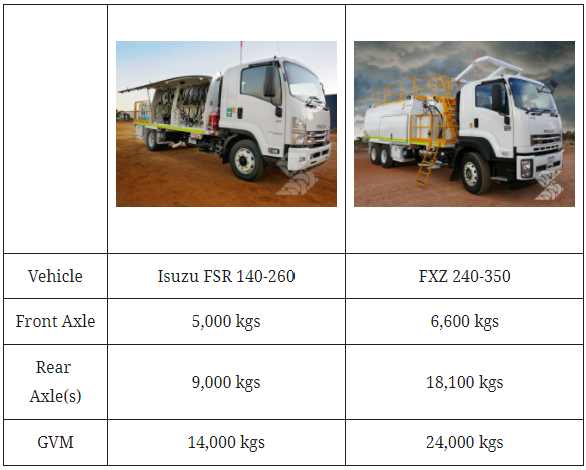
The Gross Vehicle Mass (GVM) is the maximum weight of a fully loaded vehicle as specified by the manufacturer. This is equivalent to the Kerb Weight plus the weight of all accessories and the payload. The payload is the weight of everything loaded onto the vehicle, which includes the driver and passengers.

The payload carried by a vehicle must be properly distributed to ensure it does not exceed the maximum load that the front and rear axles can carry, as specified by the manufacturer.

The Kerb Weight less the GVM is the total payload capacity – the total weight of accessories, cargo, and people that the vehicle can transport without towing a trailer.

If a vehicle is towing a trailer, several additional factors must be considered to ensure a vehicle can reliably and safely tow a specified load and can launch – move a load from a complete stop, accelerate and climb.

The Trailer Weight (TARE) is the weight of an empty trailer, while the Gross Trailer Weight (GTW) is the maximum axle load that the trailer can carry as specified by the manufacturer.

When towing a trailer, the bulk of the trailer weight is taken by the trailer wheels, but a small proportion is passed to the towing vehicle via tow bar. The Tow Bar Download (TBD) is typically between 10% and 15% of the GTW, and together, the TBD and the GTW form the Aggregate Trailer Weight (ATW) which is the maximum towing weight as specified by the manufacturer.

Finally, the Gross Combination Mass (GCM) is the maximum combined weight of a vehicle and trailer as specified by the vehicle manufacturer. In the same way that cargo on the towing vehicle needs to be properly distributed to not exceed the axle capacities, so too does cargo on the trailer. As a rule of thumb, approximately 60% of the load should be in the front half of the trailer but it is important to note that overloading the front of a trailer will increase the TBD and potentially exceed the 15% range which may result in impairment of vehicle performance.

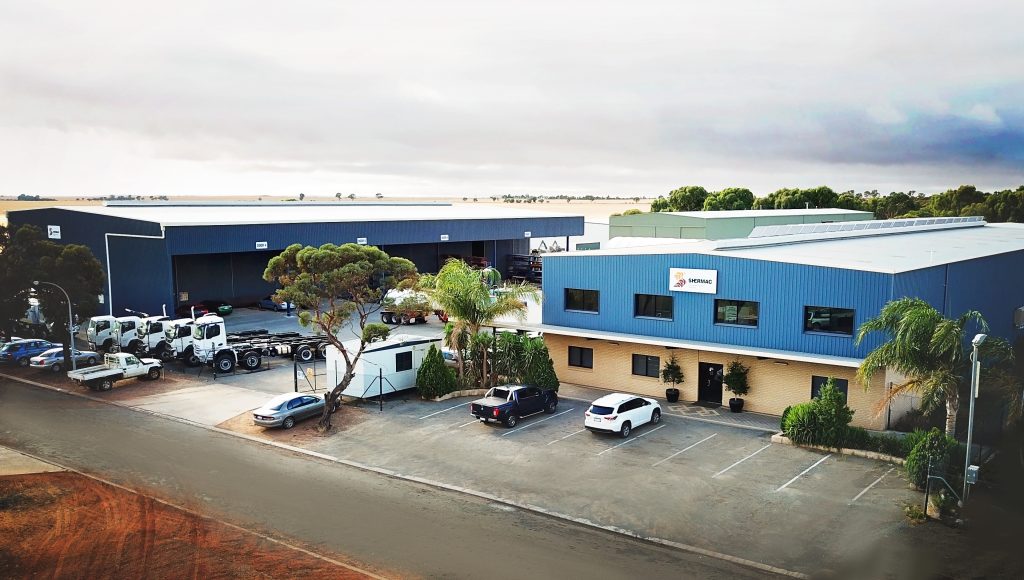
Headquartered in regional Western Australia, Shermac has been designing and manufacturing high quality, engineered-for-purpose mobile equipment in the mining, civil and commercial sectors since 2002.

Shermac engineers utilise world-class technology that allows them to exactly measure vehicle and trailer load, and weight distribution and compliance is verified at several stages in the Shermac design process. An initial weight report is submitted at quotation, another is submitted at completion of detailed design and engineering, and a final weight report is submitted pre-delivery.

Weight distribution is the amount of the total vehicle weight imposed on the ground at an axle, group of axles, or an individual wheel. The weight on a truck must be distributed on the axles to comply with the chassis manufacturer’s axle ratings and weight laws. 

Axle capacities are limited either by the axle capacity or legal weight limits, whichever is lower. In addition to axle capacities, the Gross Vehicle Mass (GVM) is the maximum operating weight of the vehicle specified by the manufacturer, which takes the cab and chassis, engine, and every other component of the truck into account. 

The centre of gravity of an object is a hypothetical point at which weight is evenly dispersed and all sides are in balance. Each truck component, including passengers and cargo, have a centre of gravity.  

In physics, “moments” are a force or weight times a distance. Moments provide a way to combine several components or items to calculate a centre of gravity for them as a group. When the centre of gravity is known for all items combined, it is possible to calculate the weight on each axle. 

From a vehicle owners’ perspective, it is important to match the capacity of the truck to the weight it is expected to carry. An overloaded truck is unsafe and illegal but if a truck consistently hauls less than its capacity, the owner is not realising a full return on investment and operating costs will be higher than they should be. 

In addition to being illegal and the risk of penalties, improper weight distribution and overloading cause excessive wear and premature failure of parts, unsafe operation such as compromised directional control and insufficient braking capacity and additional stresses that may be instrumental in causing the frame to crack or break. 

Careful consideration must be given to distribution of the load weight to determine how much of the total, including chassis, cab, body, and payload, will be carried on the front axle and how much will be carried on the rear axle, and the total. Moving components a few inches forward or backward on the chassis can mean the difference between acceptable weight distribution for the truck or an application that will not do the job satisfactorily. 

Headquartered in regional Western Australia, Shermac has been designing and manufacturing high quality, engineered-for-purpose mobile equipment, including custom service trucks, in the mining, civil and commercial sectors since 2002.

If you have a technical query or would like to discuss your next project, call our team on 1300 799 943 or email [email protected] with your inquiry.   

On average, in the Australian manufacturing industry, 8% of people change jobs every year. At Shermac, the figure is less than a quarter of the national average, and once people start working for Shermac, they often stay and become long-term employees. 

We spoke to Shermac Chief Executive, Mike Ray. 

We value and respect our staff and we look after them well 

‘Shermac is a stable, family-owned and operated business that has enjoyed long-term growth. We employ a diverse, highly skilled and multi-cultural staff of more than 50 people. We work hard to offer our staff a safe, supportive work environment and create a mutually beneficial experience’ 

Shermac manufacture specialised purpose-built service vehicles designed for the mining and construction industries. Clients are highly demanding and run 24 x 7 x 365 operations in some of the most hostile environments on earth. Mike Ray said, ‘We believe that we manufacture the best equipment of its type in the world, and we have extremely high standards. Our staff take immense pride in the equipment we build. Every job we do is different, and we encourage our staff to draw on their experience and tell us where opportunities exist to do things better and where we might improve.’ 

Shermac are an end-to-end fabricator and doing everything in-house not only enables the company to control every aspect of production and quality but also exposes staff to a wider range of activities than most fabricators and creates opportunities to improve their skills and develop new ones. 

Mike Ray said, ‘We We operate from a state-of-the-art manufacturing facility, and we are constantly updating our processes to keep up with the latest equipment and technological advances to maximise efficiency. We have recently constructed a purpose-built heavy fabrication workshop to build large tank modules and install completed modules on off-road chassis. This facility included an industry-first custom-engineered tank rotation system where equipment, mounted in a floor pit, is connected to the tank which can be lifted and rotated as needed.’

Treating people well is hard-wired into our DNA 

‘It doesn’t matter whether you are a team member, a supplier, or a customer, we treat everyone with decency and respect. We want everyone who comes in contact with Shermac, whether it’s a local work-experience student, a delivery driver or a multi-million dollar customer, to have a positive experience.’ 

‘We treat our customers the same way we would treat a guest in our home. We do everything in our power to ensure that their needs are met and that we provide not only the best solution to their problems, but also the best possible customer experience.’ 

We actively support the community that is our home 

Shermac’s home is Dalwallinu - a small town in the Wheatbelt region of Western Australia, approximately 250km Northeast of Perth.  

‘Over the years, we have become a major employer in Dalwallinu, and we acknowledge and embrace our responsibilities to our home community. We actively play our part in supporting the economic and social viability of the community in which we live and work.’ 

‘This community perspective is apparent in everything we do. While we have always endeavoured to hire and spend locally, we have sponsored skilled migrants and are delighted that they have become active members of the local community and now consider Dalwallinu as their home. We offer work experience to local youths and hire apprentices from the local community.’ 

‘We sponsor and donate to local sporting, community and not-for-profit groups. We have staff members that volunteer with the local emergency services and, when they respond to local emergencies, we continue to pay them as-if they were still at work as we won’t allow them to suffer any financial penalties when supporting our community. We recently covered all costs for staff that travelled 400kms to support cyclone relief efforts in remote WA communities.’ 

‘Families are at the heart of all vibrant, caring communities and we are as flexible as we can be in terms of work arrangements and accommodating the needs of our staff to balance work and family commitments.’ 

Working with Shermac 

‘As a growing business, we’re always interested in hearing from people who’d like to join our team and if Shermac sounds like the type of business you’d like to be part of, we’d encourage people to contact us as we’d love to have a chat’. 

If you’d like to find out more about opportunities with Shermac, please call us on 1300 799 943 or email [email protected]  

On any open-pit mine, haul roads carry the weight of the entire operation. Trucks never stop moving, dust is always a factor, and road conditions can shift quickly with weather and traffic. Watering helps keep those roads safe and workable, but it’s not as simple as putting more water on the ground.

The way water is applied has a direct impact on safety, traction and road longevity, which is why the performance and consistency of your water cart play such an important role in day-to-day operations.

Why haul road watering is critical for mine productivity and safety

The road network is critical to open-pit mining. To keep productivity at an optimum level, every haul road must be properly maintained and in good condition. These roads carry continuous heavy vehicle traffic and are typically unsealed, which makes them vulnerable to many factors, including dust, surface breakdown and changing weather conditions.

Dust is a major operational and environmental concern

The New South Wales Environment Protection Authority (EPA) noted that “Dust generated from haul roads within the mines is the biggest source of fine dust particles on most mine sites, contributing about 40 per cent of total emissions”.

Effective watering is the primary method used to control dust, maintain visibility and support safe operating conditions.

Key reasons dust control matters:

  • Reduced visibility increases risk for operators
  • Air quality impacts compliance requirements
  • Fine dust affects nearby equipment and working zones

The right moisture level protects the road surface

When haul roads hold consistent moisture, the surface stays compacted and stable. This helps maintain road shape, reduces erosion and limits the maintenance required to keep roads serviceable.

Stable surface conditions support:

  • Predictable traction
  • Lower tyre wear
  • Safer braking distances
  • Reduced grader intervention

Watering directly influences productivity and safety

Watering is one of the most important routine tasks on any mine site because it shapes how reliable and safe the haul roads remain. A well-managed watering program keeps dust down, maintains surface integrity and supports efficient movement of heavy equipment across the site.

The risks of under-watering mine haul roads

Dry surfaces create dust and poor visibility

Under-watering leaves haul roads dry and dusty. When heavy vehicles move across uncompacted surfaces, fine particles lift easily and reduce visibility for operators. This affects safety across the entire work zone and can create air-quality issues that impact compliance.

Key concerns:

  • Reduced visibility increases collision risk
  • Dust impacts operator awareness and safe stopping distances
  • Airborne particles affect nearby equipment and working areas

Dry running surfaces increase wear and reduce traction

A dry wearing course breaks down more quickly under constant traffic. As fines and binding material lift from the road surface, the road becomes rougher and less predictable for operators.

Operational impacts include:

  • Increased tyre wear
  • Greater vibration through vehicles
  • Reduced traction and stability
  • Gradual loss of a compacted running surface

Productivity can slow as conditions deteriorate

As the road becomes dusty and uneven, operators often reduce speed to maintain control. Graders may need to intervene more regularly, increasing maintenance effort and interrupting haul cycles. These compounding effects create avoidable inefficiencies across the fleet.

The risks of over-watering mine haul roads

Wet surfaces lose strength and friction

Over-watering washes away the fine surface layers of a haul road and reduces the friction needed for heavy vehicles to maintain traction. This creates low-friction conditions where operators have less control, especially when braking or cornering.

Key impacts:

  • Longer stopping distances
  • Increased skid potential
  • Reduced tyre grip
  • Higher risk of vehicle slides on inclines or turns

Road quality degrades when moisture levels are too high

Excess water weakens the wearing course and leads to rapid deterioration. Material can shift or pump under load, creating soft spots, ruts and uneven surfaces that require more frequent grading.

Common issues include:

  • Surface erosion
  • Loss of compaction
  • Deformation of the running surface
  • Higher maintenance demand across the haul network

Evidence from incident data highlights the risk

A five-year review by the Queensland Department of Natural Resources and Mines recorded 477 High Potential Incidents involving vehicles losing control on mine road surfaces. The findings identified three main contributing factors:

  • Road material
  • Road geometry
  • Road watering

Inappropriate watering accounted for 49 percent of these incidents, making it the single most common factor. The review also noted that moisture-sensitive road materials, such as clays, can lose up to half of their friction coefficient when watered. Weathered overburden clays can have significantly lower friction than siltstones or sandstones, increasing the likelihood of traction loss when wet.

Incorrect watering creates unpredictable conditions for operators

Different road materials respond differently to moisture, which means a single watering approach cannot suit all areas of a haul network. When water is applied without considering material type, surface condition or vehicle speed, friction levels can vary sharply across the road. This creates inconsistent and unsafe driving conditions, even when the intention is simply to manage dust.

How operators can improve watering accuracy and road safety

Test and understand road surface friction

The Queensland Department of Natural Resources and Mines encourages operators to conduct friction coefficient testing across haul roads. Understanding how different surface materials respond to moisture gives engineering teams clearer insight into:

  • which materials hold friction under load
  • which surfaces become low-friction when watered
  • how quickly traction changes after application

This testing has helped many Bowen Basin mines reassess their road materials, refine watering practices and invest in higher-performing wearing course materials where required.

Calibrate and assess water truck performance

DNRM’s investigation identified several common issues when testing water truck calibration. These inconsistencies often contribute to over-watering or uneven water distribution, increasing the risk of slides and road degradation.

Frequent calibration helps identify:

  • identical trucks applying different water rates
  • water not being applied consistently across the travel path
  • overlapping sprays and poor spray direction
  • over-watering at low vehicle speeds
  • spray widths that are wider than required, leaving all wheels in the wet line

Regular checks ensure that watering rates match operational needs and that sprays deliver consistent, predictable coverage.

Align watering practices to road material, geometry and conditions

Different materials behave differently when wet, and moisture affects friction more severely on some surfaces than others. Clay-based wearing courses, for example, can lose up to half of their friction coefficient when watered. On steep ramps, friction reduces further due to geometry alone.

Operators improve safety by adjusting watering methods based on:

  • road gradient
  • known material sensitivity
  • traffic patterns and braking zones
  • weather conditions and moisture retention

A single watering approach rarely suits all areas of a haul network. Tailored application helps maintain safer, more predictable surfaces.

Use trained, experienced water cart operators

The Mining Inspectorate strongly recommends using experienced water cart operators who understand how watering affects friction, braking and site traffic. Proper training covers:

  • when and where to water
  • how to identify surface changes
  • how speed influences application rate
  • how to keep haul roads safe during shifts and weather changes

Skilled operators play a direct role in maintaining safe haul road conditions.

Engineering better watering outcomes with fit-for-purpose water carts

Maintaining safe and consistent haul road conditions depends on how accurately water is applied. Shermac water carts are engineered to deliver controlled, predictable coverage across varied road materials and gradients, helping operators avoid over-watering and low-friction surfaces.

Shermac’s engineered-for-purpose designs support better watering outcomes through:

  • Controlled spray output to prevent wide wet lines and inconsistent coverage.
  • Accurate application rates at different vehicle speeds, reducing the risk of over-watering on ramps or corners.
  • In-cab control systems that let operators adjust spray banks quickly and safely.
  • Stable, low centre-of-gravity tank designs for safer operation on uneven haul roads.
  • Durable, hot-dip galvanised pipework positioned externally for easier servicing and long-term reliability.
  • Quality pumping systems that maintain steady, repeatable flow rates in harsh conditions.

With purpose-built water carts, mines can maintain safer surface conditions, reduce grader intervention and support more consistent haul cycles.

Speak with Shermac’s engineering team

Keeping haul roads safe and reliable depends on how well moisture is managed.

Fit-for-purpose water carts make that work easier. With controlled spray delivery, predictable application rates and durable, mine-spec engineering, Shermac water carts help operators maintain safer surfaces and support efficient haul cycles across the site.

If you’re looking to improve watering accuracy or review your current setup, our team can walk you through the best configuration for your road conditions and fleet requirements.
The challenges presented by dust from coal mining activities is well understood. When inhaled, coal dust is a proven carcinogen and a cause of lung disease. When mixed with gas, atmospheric coal dust creates a potential explosion hazard, and it also presents equipment maintenance challenges through premature wear and breakdowns. 

Australia is the 4th largest coal producer in the world and is responsible for 6.2% of global coal production. There are approximately 400 coal mines in Australia and nearly 80% of coal is produced from open-cut mines in contrast with the rest of the world, where open-cut mining only accounts for 40% of coal production. 

Types of atmospheric particles include suspended particulate matter designated as PM10 which are coarse particles with a diameter of 10 microns or less and fine particles, designated PM2.5 with a diameter of 2.5 microns or less. 

During the extraction, transport and processing of coal in surface mining operations, significant amounts of airborne respirable dust can be generated. 

While there are rigorous safety standards to reduce the risks associated with coal dust, mine haul roads are particularly challenging. 

“Mine haul roads are generally dirt roads and sustain continuous heavy vehicle traffic” EPA’s Mark Gifford said, adding “Dust generated from haul roads within the mines is the biggest source of fine dust particles on most mine sites, contributing about 40 per cent of total emissions. 

When it is windy and dry, this [overburden] dust is more likely to leave mine sites, so tighter control is needed at these times,” Gifford said. 

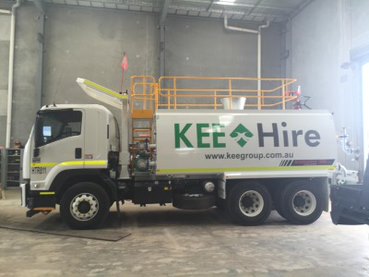
Mine roads need to be constructed and maintained to optimise the transfer of material from the point of production to processing facilities while minimising the creation of airborne dust, and one of the unsung heroes of the mining industry is the water truck. The water truck (or water cart) is essential for compaction and dust suppression on mine roads. 

Shermac was founded on the understanding that the operational needs and operating environments of customers were so diverse that standardised equipment did not offer them sufficient flexibility, and while customers were looking for customised equipment options, these were not available in the equipment manufacturers marketplace.  

Shermac will work with you to establish your strategic, operational, and budgetary requirements to build the ideal water cartage vehicle or fleet that saves you time and money. Customisation ensures Shermac water carts are fit-for-purpose, optimising productivity, utilisation and effectiveness while minimising operational risk for our customers. 

Ready to find out more? Talk to our expert team to find out more about how custom design and concept-to-delivery engineering and manufacturing capabilities can minimise project risk and ensure lowest total cost of ownership.  

Shermac has been designing and manufacturing custom-built water cartage and support vehicles for the mining, civil and commercial sectors for over 20 years. While the focus has traditionally been on road-going trucks, in response to increasing industry demand, Shermac has expanded its range of off-road vehicles. 

The physical size of these off-road vehicles requires a new approach to manufacturing and Shermac are building a specialised facility at its Dalwallinu base to accommodate industry demand. 

Off-road water carts and custom service trucks have modules that may weigh between 9 and 40 tonnes, and Shermac has constructed a 1,400 square metre heavy fabrication workshop with a 220mm concrete floor that is engineered for 50 tonne point loads. 

As tanks need to be rotated a number of times during build, a key feature of the new facility is a custom-engineered tank rotation system where equipment, mounted in a floor pit, is connected to the tank which can be lifted and rotated as needed. 

Customisation is critical

Shermac’s Chief Operating Officer Steve Ray said, ‘Shermac has been providing customised, engineered-for-purpose service vehicles to the resource sector for two decades. Customisation is critical, as vehicle design must reflect the specific operational needs for the unique environment of the customer, and Shermac’s end-to-end capability allows us to relentlessly focus on customisation, lowest lifetime cost of ownership and maximising value for our customers.’ 

Shermac’s in-house capabilities include design and engineering, procurement, complete fabrication capabilities including assembly, testing, hydraulic engineering, auto electric, paint and commissioning, and extends to transport, delivery, operator training, after-sales support and parts.  

Rather than simply upgrading our existing production facilities, we decided to separate manufacturing into road-going and off-road vehicle streams. While the new facility represents a significant investment by Shermac, it demonstrates our commitment to off-road service vehicles and is critical to increased production and ensuring the highest quality product’ 

Steve added, ‘The new facility will enable Shermac to remove off-road vehicles from our current production line and into a specialised facility. This additional production ‘swim lane’ will free-up and increase capacity for our standard range and significantly reduce build-time for tanks for off-road vehicles.’ 

‘This also marks important expansion for Shermac. We are an Australian family-owned business who are passionate about supporting regional Australia and we’re delighted that our expansion is creating additional employment opportunities here in Dalwallinu and helping to support our local community.’ 

Shermac design and manufacture custom-built water cartage and support vehicles for the mining, civil and commercial sectors. While manufacturing is based in Western Australia, through a national footprint of support offices, we serve customers Australia-wide. 

Shermac has designed, engineered and fabricated products for some of the worlds’ largest mining and civil engineering contractors, including BHP, Rio Tinto, Fortescue, Thiess, Komatsu and Alcoa. Much of this work has been to address highly specialised requirements demanding one-off engineering solutions to operate in some of the most hostile environments on earth. 

In addition to corporates and multinationals, Shermac has successfully completed a large number of projects for smaller and owner-operated businesses. 

Shermac believe it is entirely reasonable for a customers to ask “Why should we use Shermac?” 

Shermac CEO, Mike Ray says,”We must differentiate ourselves on dimensions that are relevant and meaningful to our clients. Based on our experience, there are three key dimensions that are important to our clients – minimising supply risk, eliminating operation risk and lowest lifetime cost of ownership”. 

Minimising supply risk 

One-stop describes an end-to-end process that takes a service from beginning to end and delivers a complete functional solution. Shermac is a partner that can see a project through from beginning to end, and supply everything needed to create a workable solution.  

Shermac’s in-house capabilities include design and engineering, procurement, complete fabrication capabilities including assembly, testing, hydraulic engineering, auto electric, paint and commissioning, and extends to transport, delivery, operator training, after-sales support and parts.  

From Shermac’s perspective, this end-to-end capability is the realisation of a philosophy that helps to optimise the performance and efficiency of the business by eliminating the middle-man and provides a much more predictable cost base with complete control over quality and improved management of project timelines.  

From a customer perspective, it means that Shermac has a complete and unbroken line-of-sight from initial concepts through to final delivery and has full accountability for every aspect of the project.  

While many contractors may argue they have one-stop capability, this often only applies to fabrication of standard, off-the-shelf products, and any level of customisation will require extensive use of third parties for design, sourcing and fabrication, with the resultant loss of control and breakdown of the accountability trail. 

Eliminating operational risk 

Shermac was founded on the understanding that the operational needs and operating environments of customers were so diverse that standardised equipment did not offer them sufficient flexibility, and while customers were looking for customised equipment options, these were not available in the equipment manufacturers marketplace. 

Customisation ensures Shermac equipment is fit-for-purpose, optimising productivity, utilisation and effectiveness, and minimising operational risk for our customers. 

The Shermac team has a deep understanding of operating in remote areas of Australia, so we can relate to the tough conditions that customers deal with on a daily basis, and the company has unprecedented experience in custom-built, fit-for-purpose and lowest cost of ownership service vehicles for mining, civil and commercial environments.  

Lowest total cost of ownership 

Total cost of ownership (or TCO) includes the purchase price of a particular asset plus all operating, service, maintenance and repair costs over the asset’s lifespan, including cost of disposal and residual value on disposal.  

For assets with a long service life, the initial up-front cost of a product is often only a small part of TCO and purchasing managers know that while good procurement is achieving the right price, best value for money is the lowest lifetime cost.  

While minimising lifetime operating and asset care costs requires best practice by management, the manufacturer can make a significant contribution to TCO through quality design, engineering and product build. There are three critical factors in managing TCO to minimise the incurred cost of operations and maintenance. 

The most crucial factor in minimising TCO is to ensure that operating practices adhere absolutely to operations within the asset’s designed operating envelope. This highlights the critical importance of customisation to ensure that each asset is designed to perform a specific range of work and bound by a specific range of inputs and outputs.  

A second critical requirement is effective operator care. The operator plays a vital role in controlling total cost of ownership as properly maintained assets require less energy, can consistently maintain rated performance and generate near perfect product quality. Shermac design and engineer equipment to ensure that operator maintenance can be performed quickly and easily including ‘self-reporting’ products that alert the operator to maintenance needs.  

Finally, in conjunction with proper operation, effective asset care has a direct impact on total cost of ownership, including preventative maintenance, scheduled replacements and periodic rebuilds. Again, Shermac’s focus on details such as chassis selection, product selection and durability, ease of access and maintenance and availability of spare parts all contribute to effective asset care.  

Shermac’s end-to-end capability allows us to relentlessly focus on customisation, operator maintenance and asset maintenance ensuring lowest lifetime cost of ownership and maximising value for our customers. 

The globalised mining industry is a competitive space. Operators are continually looking to achieve higher production rates by utilising more reliable equipment with higher performance capabilities. The mining industry is a punishing environment and equipment is subject to degradation from the moment it enters service. 

Total cost of ownership (or TCO) represents the total cost required to own and operate equipment and includes the purchase price plus all operating, service, maintenance and repair costs over the asset’s lifespan, including cost of disposal and residual value on disposal.  

Given all of these factors, a key question for maintenance and asset managers is when to replace equipment to minimise cost? The optimum replacement age of equipment is defined as the time at which the total cost is at its minimum value. To keep equipment operating past this point will increase total costs and result in negative economic consequences. 

TCO analysis helps decision makers justify equipment replacement on the basis of total costs over the equipment’s useful life and allows the maintenance manager to specify the optimal replacement date at the time of equipment purchase. 

The timing of retiring equipment assets and replacing with new equipment is carefully planned and there is a long lead time for decision-making. 

Failure to effect a change over as planned might have significant financial consequences as the operator might have to perform expensive maintenance and rebuilds that cannot be fully amortised by the time the equipment is replaced. 

Shermac are wise to this issue and understand the critical importance that maintenance and asset managers attach to delivery timing. 

Shermac has been providing customised, engineered-for-purpose service vehicles and water carts to the resource sector for two decades. Over this time, Shermac has evolved into a ‘one-stop shop’, that can see a project through from beginning to end, and supply everything needed to create a workable solution. 

Shermac’s in-house capabilities include design and engineering, procurement, complete fabrication capabilities including assembly, testing, hydraulic engineering, auto electric, blast/paint and commissioning, and extends to transport, delivery, operator training, after-sales support and parts. 

This end-to-end capability helps to optimise the performance and efficiency of the Shermac business by eliminating the middle-man and providing a much more predictable cost base with complete accountability for quality and project timelines. For customers, it means that Shermac has an unbroken line-of-sight from initial concepts through to final delivery that minimises delivery timing risk and supports total cost of ownership goals of maintenance and asset managers. 

Shermac has been providing customised, engineered-for-purpose service vehicles and water carts to the resource sector for two decades. Over this time, Shermac has evolved into a ‘one-stop shop’, and in this blog, we’d like to examine why this is important and how it benefits customers.

One-stop describes an end-to-end process that takes a service from beginning to end and delivers a complete functional solution. Shermac is a partner that can see a project through from beginning to end, and supply everything needed to create a workable solution.

Shermac’s in-house capabilities include design and engineering, procurement, complete fabrication capabilities including assembly, testing, hydraulic engineering, auto electric, blast/paint and commissioning, and extends to transport, delivery, operator training, after-sales support and parts.

From Shermac’s perspective, this end-to-end capability is the realisation of a philosophy that helps to optimise the performance and efficiency of the business by eliminating the middle-man and provides a much more predictable cost base with complete control over quality and improved management of project timelines.

From a customer perspective, it means that Shermac has a complete and unbroken line-of-sight from initial concepts through to final delivery and has full accountability for every aspect of the project.

While many contractors may argue they have one-stop capability, this often only applies to fabrication of standard, off-the-shelf products, and any level of customisation will require extensive use of third parties for design, sourcing and fabrication, with the resultant loss of control and breakdown of the accountability trail.

There are two key elements here. Customisation is the norm and is critical as vehicle design must reflect the specific operational needs for the unique environment of the customer. Customisation is not just tinkering with standard designs and configurations. It means ground-up design that reflects the specific operational needs and unique operating environment of the customer.  When it comes to service vehicles, one-size definitely does not fit all.

If, for example, a client’s operational needs demand a non-standard hydraulic system that required the services of a third-party contractor, and there was a subsequent issue with the system, it can be a nightmare for the client to identify and contact the contractor for documentation, servicing and repairs. With Shermac, all these processes are completed in-house by our team of specialists, meaning one point of call for the client if there are any queries down the track.

For Shermac, customisation is part of our DNA and the natural accompaniment to customisation is concept-to-delivery engineering and manufacturing capabilities. Not only does this ensure a product that is designed to perform as intended within defined parameters, it also ensures complete control over quality and project timelines while ensuring transparency and accountability that minimises buyer risk and minimises total cost of ownership.

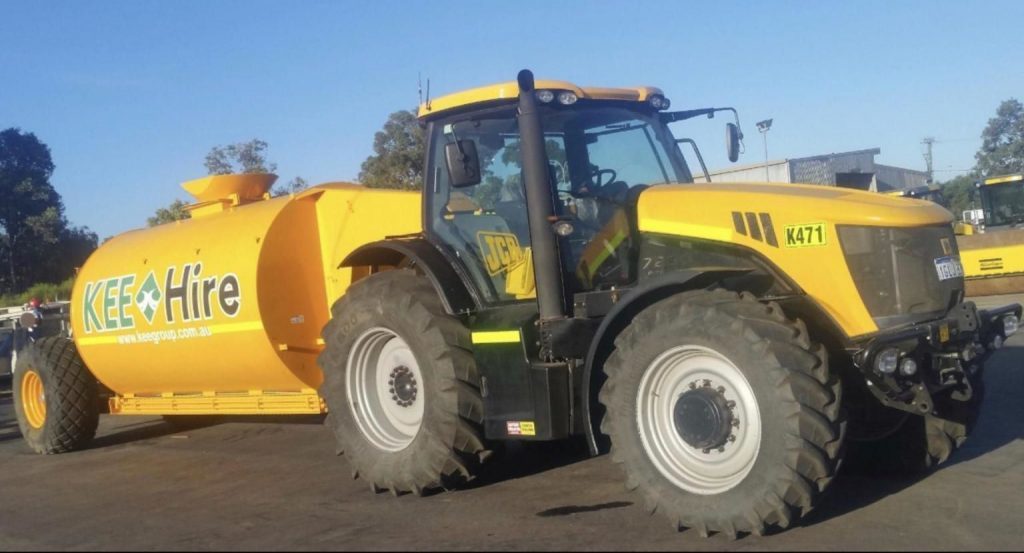
KEE Group is a unique WA family-owned and multi-faceted civil and mining support services provider with four divisions: 

KEE Hire: Full-service provision with an inventory of over 600 pieces and growing 

KEE Transport: A 24/7 service provider that will deliver what is promised Australia wide 

KEE Surfacing: Exceptional quality asphalt, spray seal, profiling and base course services and a demonstrated capacity of delivering the largest projects. 

KEE Fuel: Discounted onsite delivery direct to machinery and bulk tanks 

Co-founder Damon Spiers said ‘Above absolutely everything else we do, we want to be known as Australia’s leading civil, mining and construction support service. We want our clients to know that we can offer the complete package from plant and equipment supply, to fueling, maintenance and transportation’, and added ‘we do this by utilising the industry’s best and brightest to deploy the highest possible quality equipment and solutions, enabling our clients to efficiently and safely achieve their goals’ 

‘We are mindful that project managers are looking for the simplest solutions without compromising on quality. This is what gives us the edge. Offering a comprehensive range of services, there’s no reason to go elsewhere or contact a range of different providers’ 

When evaluating suppliers to his business, Damon said, ‘We only work with suppliers that genuinely share our worldview and they need to stand behind their product. We like to work with Shermac. We have an alignment of values and a very similar ethos to Shermac. They are a successful business, a great company to work with and, simply, nice people’ 

Damon added, Shermac are not always the cheapest but for overall service provision and value for money, they are the standout supplier. I’m over dealing with suppliers that don’t deliver. We never have any issues with Shermac. They produce an exceptional product and provide exceptional support. Our customers get the best, and we chose to work with Shermac because they are the best’ 

Stay Updated